

How to Stay Focused While Working: 7 Proven Strategies
Table of Contents
- Why Staying Focused While Working Is Harder Than It Used to Be
- Time Management Techniques That Build Sustained Concentration
- Productivity Hacks for Deep Work That Actually Stick
- Set Clear Goals and Priorities at the Start of Every Day
- Benefits of Mindful Coffee Breaks for Focus and Energy
- Create a Dedicated Workspace That Supports Deep Focus
- Recovery and Energy Management: The Missing Half of Staying Focused While Working
- Conclusion
Last Updated: August 23, 2026
Why Staying Focused While Working Is Harder Than It Used to Be
Staying focused has never been more complicated. The modern work environment stacks the deck against concentration: open-plan offices, messaging apps that interrupt every eight minutes, and an always-on digital culture all chip away at sustained focus. Distraction is now a design feature, not a bug. Social platforms, communication tools, and news feeds are engineered to pull your attention away from whatever you were doing.
This guide covers seven evidence-based strategies to help you stay focused, build deeper concentration, and protect your most productive hours.
The Neuroscience of Focus: What Your Brain Is Actually Doing
Focus is the brain's capacity to selectively attend to one stimulus while filtering out competing inputs. It is not a personality trait or willpower contest, it is a neurological process governed primarily by the prefrontal cortex, which handles executive function, decision-making, and goal-directed behavior.
The brain does not switch between tasks instantly. According to research published through the American Psychological Association's cognitive science resources, task-switching carries a measurable cognitive cost. Every interruption forces your prefrontal cortex to reload context, burning mental energy and extending the time it takes to return to deep work. Flow state, the condition of complete absorption in a challenging task, requires roughly 15-20 uninterrupted minutes to enter. The goal of most focus strategies is simply to protect those uninterrupted windows long enough for your brain to shift gears.
Focus for Neurodivergent Brains: Different Wiring, Different Strategies
The standard advice about focus, sit quietly, eliminate all noise, work in long unbroken blocks, was designed around a neurotypical baseline. For people with ADHD, autism spectrum conditions, or sensory processing differences, that advice often backfires.
Many people with ADHD find that low-level background noise or ambient music actually improves concentration by occupying the part of the brain that seeks stimulation. Body doubling, working alongside another person even silently, is another approach that many neurodivergent workers find effective for reducing procrastination and sustaining attention.
Understand your own cognitive wiring before borrowing someone else's system. What creates mental clarity for one person creates cognitive overload for another.
Time Management Techniques That Build Sustained Concentration
Protecting your attention requires structure. Without it, the day fills up with reactive tasks and low-priority interruptions that crowd out the work that actually matters.
Time Blocking: Protect Hours Like Meetings
Time blocking is the practice of scheduling specific tasks into dedicated calendar slots, treating those blocks with the same commitment you would give a client meeting. Time blocking forces a confrontation with reality: you cannot schedule 14 hours of work into an 8-hour day.
A practical approach:
- Identify your two or three highest-value tasks for the day
- Schedule those tasks into your first productive hours, before reactive work begins
- Group similar tasks into the same block to reduce context-switching
- Leave buffer blocks between major tasks for transitions and unexpected demands
- Treat your focus blocks as non-negotiable unless something genuinely urgent arises
Task batching, a close relative of time blocking, means grouping similar low-cognitive tasks together, answering all emails in one 30-minute block rather than responding to each one as it arrives. This preserves your deeper concentration windows for the work that actually requires them.
The Pomodoro Technique and Task Batching
The Pomodoro technique structures work into 25-minute focused intervals separated by 5-minute breaks. After four consecutive intervals, you take a longer break of 15-30 minutes. The method works because it makes concentration feel finite and manageable. Short mental breaks allow attention to reset, preventing the cognitive fatigue that accumulates during long uninterrupted sessions.
Productivity Hacks for Deep Work That Actually Stick
Most productivity hacks fail because they treat symptoms rather than causes. Genuine deep work requires both environmental design and internal preparation.
Eliminate Distractions Before They Happen
The most effective distraction management is proactive, not reactive. A pre-work distraction audit takes about five minutes and changes the entire shape of a focused session:
- Phone on silent and face-down, or in another room
- Browser notifications disabled for all non-essential apps
- Email client closed, not minimized
- Workspace physically cleared of unrelated materials
- A single task written down as the session's objective
- Water or your preferred beverage already at your desk
Every time you leave your workspace for something small, you break the concentration arc. Set up your environment before the session begins, not during it.
Digital Hygiene Beyond Turning Off Notifications
Turning off notifications is a starting point, not a complete strategy. Most people do not realize how much of their attention budget is consumed by ambient digital noise: unread email badges, social media feeds left open in background tabs, and habitual checking behavior. Research from the University of California Irvine on attention recovery shows it takes an average of over 23 minutes to fully return to a task after an interruption.
Practical digital hygiene habits worth building:
- Schedule two or three designated email check times per day rather than leaving the inbox open
- Use a separate browser profile for focused work with only work-relevant extensions
- Log out of social platforms during focus hours rather than relying on willpower alone
- Apply a "one screen" rule during deep work sessions: no secondary devices
Set Clear Goals and Priorities at the Start of Every Day
The biggest reason people struggle to stay focused while working is not distraction, it is ambiguity. When you are unclear about what matters most, the brain defaults to whatever feels easiest or most urgent, which is rarely the same as what is most important.
A structured daily planning practice, five to ten minutes at the start of each morning, resolves this. The most useful framework distinguishes between urgent and important tasks. Urgent tasks demand immediate attention; important tasks move your long-term goals forward. Most people spend their days trapped in the urgent quadrant, never reaching the work that actually matters.
| Priority Type | Characteristics | Approach |
|---|---|---|
| Urgent + Important | Deadlines, crises | Do immediately |
| Important, Not Urgent | Strategy, deep work | Schedule in focus blocks |
| Urgent, Not Important | Most interruptions | Delegate or batch |
| Neither | Busywork, low-value tasks | Eliminate or minimize |
Write down your top three priorities before opening any communication app. This single habit acts as a cognitive anchor for the day, reducing the mental energy spent deciding what to work on next. Harvard Business Review's research on goal-setting and performance consistently supports the finding that specific, written goals produce better outcomes than vague intentions.
Benefits of Mindful Coffee Breaks for Focus and Energy
Breaks are not a concession to weakness, they are a functional part of sustained concentration. The brain's attention system operates in cycles, and working through natural energy dips degrades the quality of the work produced.
A mindful coffee break, one taken intentionally and away from screens, serves a different function than the habitual coffee refill grabbed while scrolling through email. The ritual of stepping away, preparing something with care, and allowing your mind to disengage briefly is a genuine cognitive reset.

A cup that you actually look forward to, made from beans with distinct character, creates a sensory anchor for the break itself. Quire Brew's Coffee with Mushrooms Dark Roast combines specialty-grade coffee with Lion's Mane, Cordyceps, and Reishi mushrooms, functional ingredients associated with cognitive support.

The structure of an effective mindful break:
- Step away from your primary workspace
- Prepare your coffee or tea without multitasking
- Spend 5-10 minutes away from screens
- Return to your desk with a clear intention for the next work block
Practicing mindfulness during these intervals has been shown to reduce cognitive fatigue and improve subsequent concentration.
Create a Dedicated Workspace That Supports Deep Focus
Your environment shapes your behavior more than your intentions do. A workspace optimized for focus reduces the friction between deciding to work and actually doing it.
A dedicated workspace does not require a separate room. It requires consistency. Working from the same physical location for focused tasks trains the brain to associate that environment with concentration, reducing the warm-up time needed to enter a productive state.
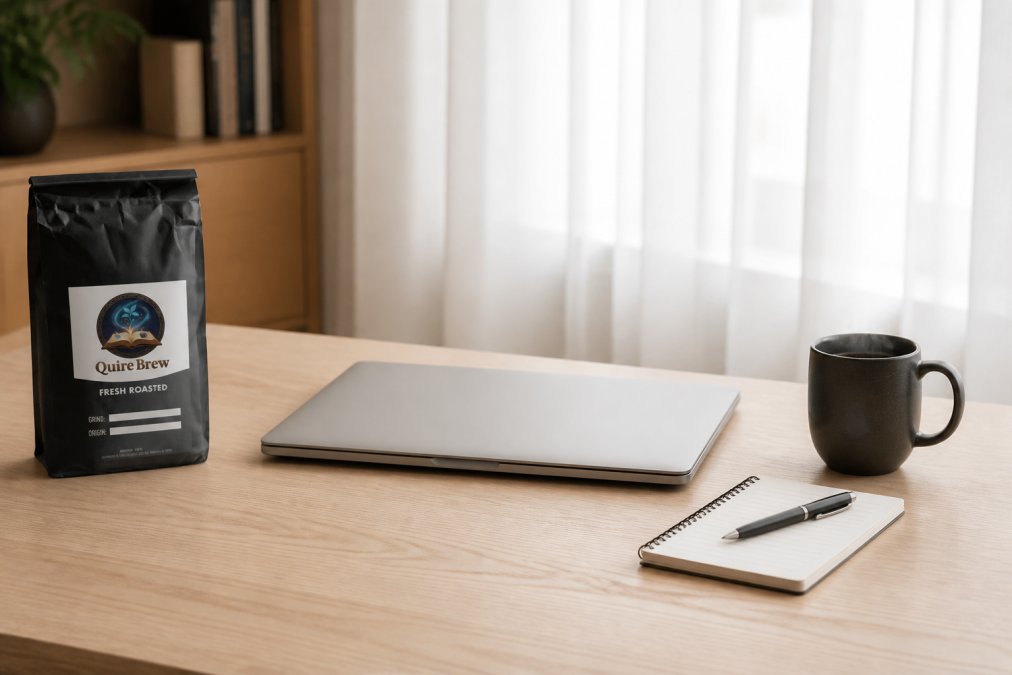
Practical workspace adjustments that support deep work:
- Keep your desk surface clear of everything except what the current task requires
- Control ambient noise with noise-canceling headphones or consistent background sound
- Position your monitor at eye level to reduce physical fatigue during long sessions
- Keep a physical notebook nearby for capturing thoughts that would otherwise interrupt your focus
- Have your preferred beverage ready before the session starts
Recovery and Energy Management: The Missing Half of Staying Focused While Working
You cannot stay focused while working if your baseline energy is depleted. Focus is not a skill you practice in isolation, it is a function of your overall physiological and psychological state.
Sleep is the most significant variable. Consistent, adequate sleep improves attention span, working memory, and the ability to filter distractions. Physical movement is the second major lever. Even short walks during the workday improve blood flow to the prefrontal cortex and reset attention, as outlined in the CDC's physical activity and cognitive health resources.
Energy management across the day also means respecting your chronotype. Most people have a natural peak performance window, typically mid-morning for morning types, that represents their highest cognitive capacity. Scheduling deep work during that window and administrative tasks outside it is one of the highest-use changes you can make.
Recovery habits worth building:
- Protect 7-9 hours of sleep as a non-negotiable foundation
- Schedule movement breaks, even brief ones, between focus blocks
- Eat in ways that avoid sharp energy crashes during core work hours
- End your workday with a deliberate shutdown ritual to prevent burnout and support recovery
| Strategy | Primary Benefit | Best Applied When |
|---|---|---|
| Time blocking | Protects deep work windows | Daily planning |
| Pomodoro technique | Structures focus and recovery | Task execution |
| Digital hygiene | Reduces ambient cognitive load | All day |
| Mindful coffee breaks | Resets attention between blocks | Mid-morning, mid-afternoon |
| Dedicated workspace | Reduces warm-up friction | Start of each session |
| Goal-setting ritual | Eliminates decision fatigue | Each morning |
| Energy management | Sustains focus capacity long-term | Weekly and daily habits |
The goal is not to squeeze every minute from your day. The goal is to protect the hours when your brain is genuinely capable of the work that matters most to you.
Staying focused is a genuine challenge, and generic advice rarely addresses the real obstacles: cognitive wiring differences, depleted energy reserves, and environments that were never designed for concentration. Quire Brew exists for people who treat their daily rituals, including their morning coffee, as intentional investments in clarity and focus. The Max Caf Blend, a high-caffeine blend of Tanzania and India Robusta, is built for the mornings when you need to bring full attention to demanding work. Subscribe to Quire Brew emails for more on building routines that support the way you actually want to work.

Frequently Asked Questions
What is the 3-3-3 rule at work?
The 3-3-3 rule is a simple daily planning structure: spend three hours on your most important project, complete three smaller tasks, and do three maintenance activities like emails or admin. It prevents the common trap of filling a workday with low-priority busywork. By anchoring your schedule around one deep-work block first, you protect your sharpest cognitive hours for the work that moves the needle most. It pairs well with time blocking and a clear morning routine.
Why am I struggling to stay focused at work?
Difficulty staying focused while working usually comes from a combination of cognitive overload, poor sleep, constant notifications, and an unclear sense of task priority. When your brain doesn't know which task matters most, it defaults to the easiest or most stimulating one, which is often a distraction. Underlying factors like stress, low energy, or neurodivergent attention patterns also play a significant role. Addressing sleep quality, reducing digital interruptions, and setting explicit daily goals tend to produce the fastest improvements.
How does caffeine intake affect long-term concentration?
Caffeine blocks adenosine receptors in the brain, which reduces the sensation of fatigue and sharpens short-term attention. Timed well, a cup of coffee before a focused work block can meaningfully improve concentration and reaction speed. The risk is relying on caffeine to compensate for poor sleep or skipping it at the wrong time, which can cause afternoon crashes. Functional blends that combine caffeine with adaptogens like Lion's Mane may support more stable, sustained mental clarity compared to caffeine alone.
How do I train my brain to stay focused for longer?
Focus is a trainable skill, not a fixed trait. Start with short, distraction-free work sessions of 25 minutes and extend them gradually as your attention span builds. Single-tasking, where you commit to one task at a time, reduces cognitive load and makes it easier to enter a flow state. Mindfulness practices, even five minutes of intentional breathing before a work session, have been shown to improve sustained attention. Consistent sleep, physical movement, and structured routines reinforce these gains over time.
This article was written using GrandRanker