

Coffee Subscription Service Comparison 2026
Table of Contents
- How We Evaluated Each Coffee Subscription Service
- Coffee Subscription Service Comparison: Pricing, Flexibility, and Roast Range
- Best Artisan Coffee Subscription for Home Use
- Coffee Subscription Frequency Guide: Matching Cadence to Your Habit
- How to Choose a Coffee Subscription That Fits Your Routine
- Environmental Impact and Packaging: What Most Comparisons Skip
- Conclusion
Last Updated: August 24, 2026
Picking the right coffee subscription service is harder than it looks. Most comparison guides skim the surface: a few roast descriptions, a price, and a vague "best for" label. At Quire Brew, we've evaluated subscriptions across roast range, delivery flexibility, cancellation friction, environmental impact, and actual value per cup. The core argument: most coffee subscriptions optimize for novelty over consistency. The best service matches your brewing method, your cadence, and your tolerance for commitment.
How We Evaluated Each Coffee Subscription Service
A good coffee subscription delivers freshly roasted, correctly ground coffee at the right frequency, with enough flexibility to pause or cancel without penalty. Our evaluation framework covered five dimensions:
- Roast range and sourcing transparency: Does the service offer single-origin options with real tasting notes and grower information?
- Subscription flexibility: Can you adjust frequency, skip a delivery, or cancel without contacting customer support?
- Value per cup: What does each cup actually cost when you account for shipping?
- Brew method alignment: Does the service offer grind customization?
- Environmental practices: What does the packaging look like, and is there any effort toward sustainability?
We weighted cancellation policy heavily, because this is where subscription services reveal their true character. According to Specialty Coffee Association industry overview, specialty coffee is defined by a score of 80 or above on a 100-point cupping scale, a standard that separates commodity arabica from genuinely traceable, high-quality beans. We used that benchmark as a baseline for evaluating roast quality claims.
Coffee Subscription Service Comparison: Pricing, Flexibility, and Roast Range
Most services cluster into two tiers: curated discovery subscriptions that send you something new each cycle, and replenishment subscriptions that let you reorder a specific roast on autopilot. Neither model is universally better; the right choice depends on whether you want to explore or optimize.
| Subscription Type | Best For | Typical Frequency Options | Grind Options | Roast Transparency |
|---|---|---|---|---|
| Curated discovery | Exploring new origins | Bi-weekly, monthly | Whole bean, pre-ground | Varies by provider |
| Replenishment | Consistent daily ritual | Weekly, bi-weekly, monthly | Usually customizable | High (you choose) |
| Sample pack first | New subscribers unsure of preference | One-time, then subscribe | Multiple | High |
| Espresso-focused | Espresso drinkers only | Bi-weekly | Whole bean preferred | Medium to high |
Quire Brew sits in a distinct position. Rather than locking you into a recurring mystery box, the approach starts with sample packs: the Best Sellers Sample Pack at $24.99 gives you six 2oz packs covering a 6Bean dark roast espresso blend, a Cowboy dark-medium blend, a Breakfast medium, and single-origins from Peru, Mexico, and Bali. You taste before you commit.

Value Per Cup and Cost-Per-Ounce Breakdown
Value per cup is the metric most subscription comparisons ignore. A standard 12oz bag of whole bean coffee produces roughly 22-24 cups at a standard 2-tablespoon dose. A 2oz sample produces about 3-4 cups. At $24.99 for six 2oz packs, you're paying roughly $1.00-1.20 per cup during the exploration phase, higher than a replenishment subscription, but the tradeoff is informed decision-making.
For the Quire Brew 60 Pack Single Serve Coffee Capsules at $59.99, that's $1.00 per capsule, with zero grinder required and sealed oxygen-free packaging that preserves freshness. The 12-pack at $18.99 works out to about $1.58 per capsule, which makes sense as a trial size.

Cancellation Policies and Customer Service Friction
This is where many subscription services lose trust fast. The pattern is familiar: easy online signup, but cancellation requires emailing customer support and navigating a retention flow designed to delay your exit.
Before subscribing, check for these: Can you cancel from your account dashboard without contacting anyone? Is there a clear pause option? What's the notice period before your next charge? According to FTC guidelines on negative option marketing, subscription services are required to clearly disclose cancellation terms before purchase, but enforcement varies.
Look for:
- Cancel online without contacting support
- Pause or skip deliveries from the account dashboard
- Clear notice period stated before charge (ideally 48+ hours)
- No "cancellation fee" or penalty for early exit
- Confirmation email sent immediately upon cancellation
Best Artisan Coffee Subscription for Home Use
The best artisan coffee subscription for home use delivers freshly roasted, single-origin or carefully blended beans with clear tasting notes, sourcing transparency, and enough flexibility to adjust as your taste evolves.
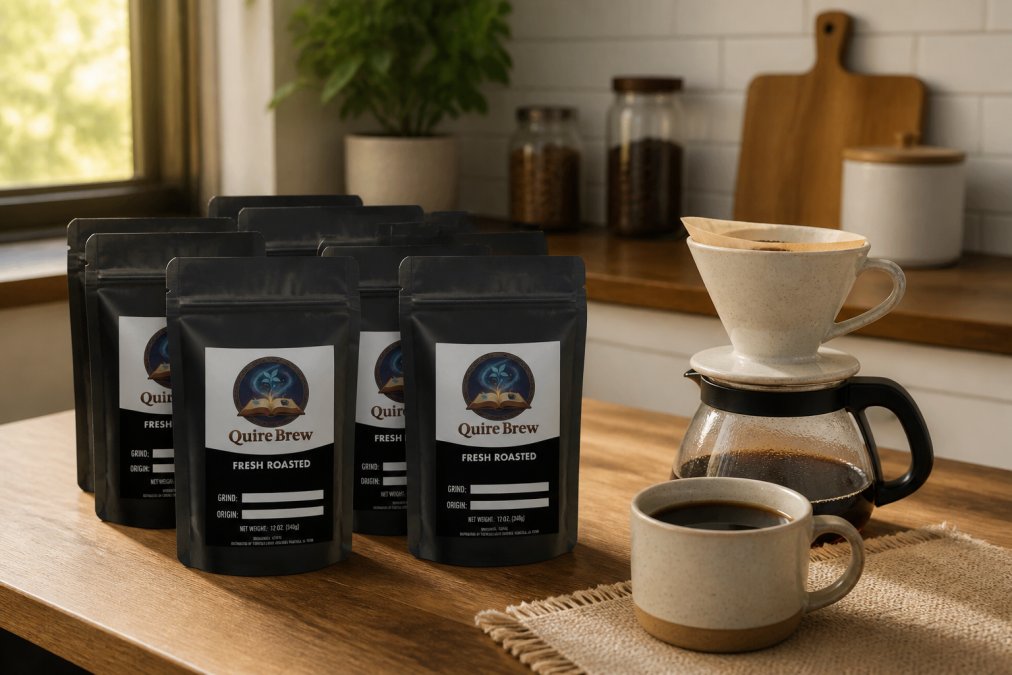
Quire Brew's Single Origin Favorites Sample Pack expresses what artisan home coffee should look like. Six origins, each in 2oz packs: Brazil Santos with cocoa notes, Colombia with dried orange and berry, Costa Rica with sweet apple and honey, Ethiopia with milk chocolate and caramel, Honduras with caramel and brown sugar, and Tanzania with pear, floral, and jasmine notes. These are real tasting profiles tied to real growers, altitudes, and processing methods, what separates specialty coffee from commodity coffee.
Single-Origin Favorites: What the Tasting Notes Actually Tell You
Tasting notes on a coffee bag are not promises; they're a map of what's possible under ideal brewing conditions. What they actually tell you is processing method and origin character. The Tanzania's floral and fruity notes come from the fully washed process and high altitude of the Mbeya region. The Ethiopia's caramel and milk chocolate come from a full natural process and indigenous heirloom cultivars.
The practical implication: if you see "fruity, bright, floral" and you prefer chocolate and caramel, choose a natural-process or wet-hulled bean from lower altitude. The Bali single-origin in the Best Sellers pack, processed via wet-hulling at 1200-1600m in Kintamani, delivers dark chocolate and molasses, a predictable outcome based on origin and process.
Espresso Blends and Brew Method-Specific Options
Espresso drinkers have specific needs that most subscription services handle poorly. An espresso blend needs to be roasted darker, ground finer, and sourced from beans with lower acidity and higher body. A light-roast single-origin that works beautifully in a pour-over will taste sour and thin as espresso.
Quire Brew's 6Bean Blend, included in the Best Sellers Sample Pack, is explicitly designed for espresso: a dark roast house blend described as "great for espresso, meticulous blend of coffee from around the world." For capsule-based espresso machines, the 12 Pack Single Serve Coffee Capsules at $18.99 offer a practical entry point with oxygen-sealed freshness and improved filter design engineered to prevent channeling.

Coffee Subscription Frequency Guide: Matching Cadence to Your Habit
Subscription frequency is the most underrated decision in the whole coffee subscription process. Order too often and you're drowning in stale beans. Order too infrequently and you're reaching for whatever's in the back of the cabinet.
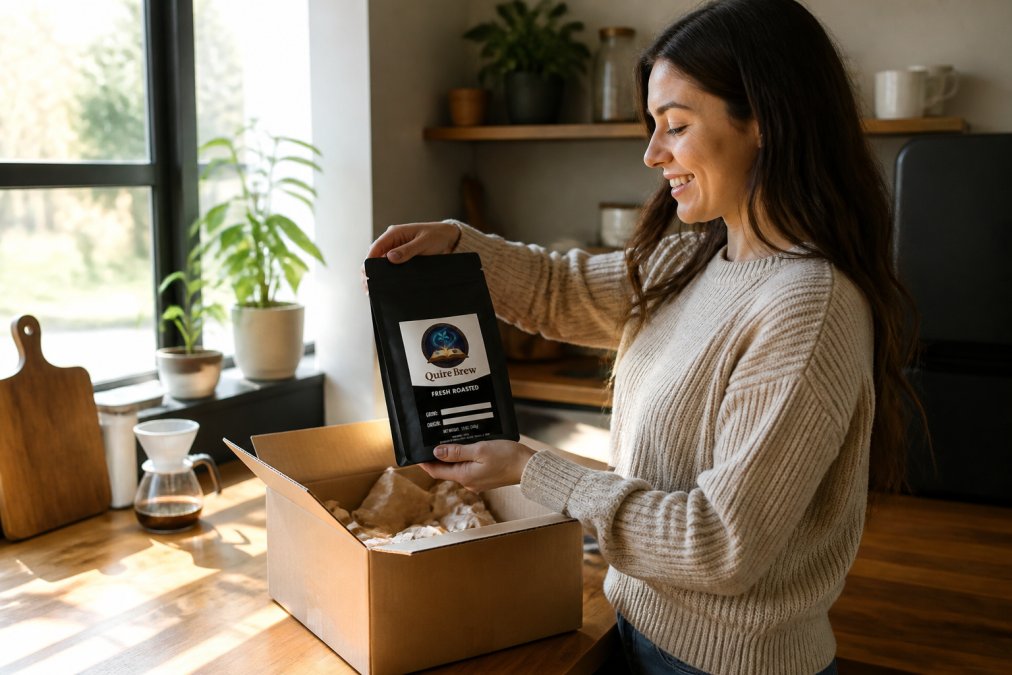
The right cadence depends on three variables: how many cups you drink per day, whether you live alone or with other coffee drinkers, and how much storage space you have for beans. According to National Coffee Association annual consumption data, the average American coffee drinker consumes just over 3 cups per day, which works out to roughly 21 cups per week. A standard 12oz bag yields approximately 22 cups, so a solo drinker averaging 3 cups per day burns through a bag in about a week. Bi-weekly subscription is the right starting cadence for most single-person households.
| Household Size | Daily Cups | Recommended Frequency | Bag Size |
|---|---|---|---|
| 1 person | 1-2 cups | Monthly | 12oz |
| 1 person | 3+ cups | Bi-weekly | 12oz |
| 2 people | 2-4 cups total | Bi-weekly | 12oz-16oz |
| 2 people | 5+ cups total | Weekly | 16oz+ |
| 3+ people | Varies | Weekly | 2lb+ |
Whole bean coffee has a longer usable shelf life than pre-ground. A whole bean bag sealed properly stays fresh for 2-4 weeks after opening. Pre-ground coffee degrades noticeably within 1-2 weeks. If you're ordering bi-weekly or monthly, whole bean is the better choice for maintaining flavor profile integrity.
How to Choose a Coffee Subscription That Fits Your Routine
Choosing a coffee subscription that fits your routine comes down to four honest questions: What brewing method do you use? How much coffee do you drink? How much flexibility do you need? And are you exploring or optimizing?
Grind Size, Whole Bean vs. Pre-Ground, and Shelf Life
Grind size is the single most consequential variable in coffee quality after bean freshness. The wrong grind produces either sour under-extraction or bitter over-extraction, regardless of how good the beans are.
The general rule:
- Coarse grind: French press, cold brew
- Medium-coarse: Chemex, drip machines
- Medium: Pour-over, AeroPress (shorter brew times)
- Medium-fine: Moka pot
- Fine: Espresso
Most subscriptions offer whole bean (grind yourself), coarse, medium, or fine pre-ground. If you're serious about flavor, a burr grinder and whole bean delivery is the better long-term investment. A roast date printed on the bag is a meaningful quality signal. If a service doesn't print the roast date, that's worth noting.
Budget-Conscious vs. Premium Tier: Where the Line Actually Falls
The meaningful line in coffee subscriptions isn't between $15/month and $30/month. It's between commodity sourcing and direct trade or direct-relationship sourcing. A budget subscription that sources commodity-grade arabica will produce a consistent, drinkable cup. A premium subscription that sources from specific farms and publishes grower names and altitudes will produce a noticeably different cup.
The Quire Brew Best Sellers Sample Pack at $24.99 sits at the boundary: specialty-grade sourcing with full provenance transparency, priced accessibly enough to explore before committing. The Flavored Coffees Sample Pack at the same price point offers six flavored medium roasts (French Vanilla, Hazelnut, Cinnabun, Caramel, Mocha, Cinnamon Hazelnut) built on specialty-grade single-origin arabica, flavored with high-quality oils while still warm from roasting. For daily drinkers who want consistency over discovery, the 60-pack capsules at $59.99 represent the clearest value proposition: roughly $1.00 per cup with oxygen-sealed freshness.
Environmental Impact and Packaging: What Most Comparisons Skip
The environmental footprint of a coffee subscription is a legitimate consideration that almost no comparison guide addresses. Packaging waste from weekly or bi-weekly deliveries adds up fast.
Evaluate: Are bags resealable and compostable, or multi-layer plastic laminates? Single-serve capsules are a particular concern; many are not recyclable through standard municipal programs. A subscription that ships one large bag every two weeks generates less packaging waste than one that ships two smaller bags weekly. Direct trade relationships tend to support better environmental practices at origin. According to Fair Trade USA standards for coffee producers, certified operations must meet environmental standards including restrictions on prohibited pesticides and requirements for waste management.
The most environmentally sound approach is ordering whole bean in larger quantities, less frequently, and investing in a grinder. That minimizes packaging per cup and maximizes freshness.
Finding a coffee subscription that genuinely fits your life requires clarity about your brewing setup, your daily volume, and how much flexibility you actually need. Quire Brew makes that process easier by letting you start with sample packs before committing to a recurring order. The Single Origin Favorites Sample Pack and Best Sellers Sample Pack give you real tasting data across six origins or blends for $24.99, with full sourcing transparency and no guesswork. Subscribe to our emails to get notified about new roasts, seasonal single-origins, and subscriber-only offers before they sell out.
Frequently Asked Questions
How do I choose the best coffee subscription for my taste?
Start by identifying your preferred roast profile, light, medium, or dark, and whether you want single-origin beans or a curated blend. Then check whether the service lets you select grind size or ships whole bean only. Sample packs are the most practical starting point: Quire Brew's Single Origin Favorites Sample Pack and Best Sellers Sample Pack (each $24.99) let you taste six distinct roast profiles before committing to a recurring order, so you build preferences on actual tasting notes rather than guesswork.
Are coffee subscriptions worth the cost compared to grocery store beans?
For specialty coffee drinkers, yes, provided the service ships freshly roasted beans with a visible roast date. Grocery store bags often sit in distribution for weeks after roasting, which dulls flavor. A coffee subscription service that sources direct-trade or fair-trade arabica and seals bags immediately after roasting delivers a noticeably fresher cup. The value per cup depends on your brewing method: capsule formats like Quire Brew's 60 Pack Single Serve ($59.99) work out to about $1 per cup, competitive with most café drip coffee.
Can I customize the frequency and roast profile of my coffee subscription?
Most artisan coffee subscription services offer at least two or three delivery cadence options, typically weekly, bi-weekly, or monthly, along with roast profile selection. The key question to ask any provider is whether you can pause a shipment without a penalty fee and how far in advance you need to make changes. Before subscribing, confirm the cutoff window for modifying orders; some services require 5-7 days' notice before the next roast date to adjust your grind size, quantity, or delivery frequency.
What is the difference between single-origin and blended coffee subscriptions?
Single-origin coffee comes from one farm, cooperative, or defined region, so the flavor profile reflects that specific terroir, Peru from Quire Brew, for example, carries salted caramel and citrus notes tied directly to its Piura growing region. A blend combines beans from multiple origins to hit a consistent, repeatable flavor profile across every roast batch. Blends tend to suit espresso brewing and everyday drinkers who want predictability; single-origin suits those who enjoy cupping different regions and tracking how processing methods shape taste.
How does automated fulfillment work for coffee subscriptions, and can unexpected charges happen?
Automated fulfillment processes your order on a set schedule based on your chosen delivery cadence, charging the card on file before each shipment. To avoid surprise charges, confirm the billing cycle timing when you sign up and check whether the service sends a pre-shipment notification, ideally 48-72 hours before processing, so you can skip, pause, or modify. Reputable services clearly display the next charge date in your account dashboard and offer a no-penalty pause option for travel or slow consumption periods.
This article was written using GrandRanker